

VPS server – is it worth it?
As digital services continue to grow, so does the number of internet-based projects – from simple corporate websites and advanced e-commerce stores to…
As digital services continue to grow, so does the number of internet-based projects – from simple corporate websites and advanced e-commerce stores to sophisticated web applications and systems supporting business processes. The increasing popularity of remote work, service automation, and moving IT infrastructure online means that a stable, efficient, and flexible server environment is becoming a key element of business operations – regardless of company size.
Traditional shared hosting, although still popular due to its low cost, often stops meeting expectations as traffic and the number of users increase. Dedicated servers, on the other hand, offer the highest performance and full control, but come with higher costs and the need for advanced administration. In this space, an intermediate solution is becoming increasingly popular – VPS (Virtual Private Server), which combines the advantages of both models.
VPS servers offer users greater independence, guaranteed resources, and the ability to freely configure their environment, while maintaining a relatively attractive price. It is therefore no surprise that they are popular among small and medium-sized businesses, startups, and development teams. However, an important question arises: is a VPS server actually cost-effective in every case? Who will benefit most from it, and when is it better to stick with simpler hosting or invest in other solutions, such as a cloud or dedicated server?
The answer depends on many factors – the scale of the project, the team’s technical expertise, the budget, and development plans. In the following sections, we will examine the advantages and limitations of VPS servers to help you make an informed decision when choosing the right IT infrastructure.
What is a VPS server?
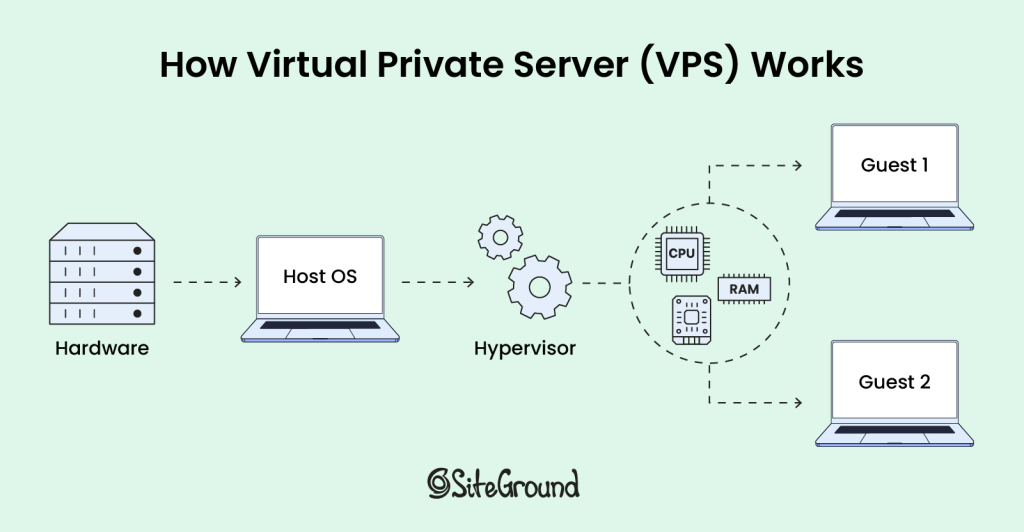
A VPS server is a virtual server environment that runs on a physical server but operates as an independent machine. Through virtualization technology, the resources of a single physical server are divided among multiple users in a controlled and isolated manner. Each VPS is a self-contained unit that, from the user’s perspective, does not differ significantly from a dedicated server.
A key element of a VPS is logical isolation – this means that the activities of other users sharing the same physical server do not directly affect the performance or security of our environment. Unlike shared hosting, where resources are dynamically shared between many websites, a VPS provides a guaranteed allocation of resources, such as:
- a specific number of CPU cores,
- dedicated RAM,
- allocated storage space (SSD or NVMe).
Each VPS server runs its own operating system, most commonly Linux or Windows Server, which the user can configure freely. Administrative access (root or administrator) allows users to install their own software, modify system settings, create users, and deploy custom solutions – from application servers and databases to test environments and containers.
Another important feature of a VPS is operational independence. A restart, failure, or overload of another VPS on the same host should not affect the operation of other virtual machines. This gives users significantly greater stability, predictable performance, and a higher level of security than traditional shared hosting.
In practice, a VPS server is a compromise between the simplicity of hosting and the power of a dedicated server. It offers considerable management flexibility and the ability to expand the infrastructure while maintaining reasonable costs, making it one of the most commonly chosen solutions for growing web projects.
It is worth taking a look at the Cloud4You offer, which provides VPS servers optimized for stability
Advantages of a Cloud Server
1. Good value for money
One of the biggest advantages of VPS servers is their cost-effectiveness. They are an attractive alternative to dedicated servers, offering a significant portion of their capabilities at considerably lower costs. For many organizations, this means access to advanced infrastructure without the need to make large upfront investments.
With a VPS server, the user receives:
- guaranteed hardware resources (CPU, RAM, storage space) that are not dynamically shared with other customers,
- the ability to install any software, frameworks, libraries, or server services,
- sufficient performance for most business applications, such as online stores, CRM systems, web applications, or development environments.
As a result, a VPS is often seen as the golden mean between inexpensive but limited shared hosting and a costly dedicated server. It allows companies to manage their IT budget efficiently while providing an appropriate level of reliability and flexibility.
2. Scalability
Another important advantage of VPS servers is the easy and fast scalability of resources. As a project grows, the infrastructure can be adapted to current needs without the need to migrate to a new server or cause service downtime.
In practice, it is possible to:
- increase the amount of RAM,
- add additional CPU cores,
- expand storage capacity (often on demand).
This approach works particularly well for projects with variable or growing workloads, such as:
- online stores (e.g. seasonal traffic increases),
- SaaS applications,
- news portals,
- marketing campaigns generating sudden spikes in traffic.
VPS scalability makes it possible to develop a project without excessive upfront investment, while maintaining readiness for future growth.
3. Independence and stability
Unlike shared hosting, a VPS server provides significantly greater operational independence. Each user operates in an isolated environment, meaning that errors, overloads, or incorrect configurations of other customers do not directly affect the operation of our server.
As a result, the user gains:
- more stable response times for applications and websites,
- greater performance predictability, regardless of the time of day or activity of other users,
- a higher level of security resulting from environment isolation and control over the configuration.
For business projects where business continuity, service availability, and a positive end-user experience are important, this is one of the key arguments in favor of choosing a VPS.
4. Full control over the environment
A VPS server provides full administrative access (root or administrator), giving the user complete control over the system environment. This is a major advantage compared to shared hosting, where configuration options are heavily restricted.
Root access allows, among other things:
- installing custom services, libraries, and frameworks,
- adjusting the operating system configuration to the specific requirements of a project,
- running containers (e.g. Docker), databases, testing environments, and staging environments,
- implementing custom security policies and automation.
For IT teams, developers, and companies developing their own applications, a VPS becomes a flexible platform for development, testing, and production, allowing the infrastructure to be fully tailored to technological and business requirements.
Disadvantages of VPS Servers
1. Technical knowledge required
Unlike shared hosting, a VPS server is not a plug-and-play solution. It offers a great deal of configuration flexibility, but at the same time places responsibility for the proper operation and security of the environment on the user. In practice, this means having at least basic technical knowledge or access to IT support, such as that offered by Cloud4You.
VPS administration includes:
- knowledge of Linux or Windows Server systems,
- configuration of firewalls, SSL certificates, and access policies,
- regular system and software updates,
- creating and testing backups,
- monitoring performance and responding to potential threats.
A lack of appropriate expertise can lead to security issues, performance degradation, or even service downtime. In such cases, it becomes necessary to purchase an additional administration service or use a managed VPS model, which increases the total cost of the solution and partially reduces its price advantage.
2. Physical server limitations
Although a VPS server is logically isolated from other virtual machines, it still operates on a single physical server. This means that in certain, albeit rare, situations, the user may experience the effects of hardware or infrastructure problems on the provider’s side.
Potential consequences include:
- short-term downtime caused by hardware failure,
- the need to migrate the VPS to another node,
- temporary performance degradation during maintenance work.
Reputable VPS providers minimize these risks by using hardware redundancy, high-availability systems, and automated migration mechanisms. Nevertheless, compared with solutions based on distributed cloud infrastructure or server clusters, a VPS remains partially dependent on a single physical host.
Who Is a VPS Worth It For?
A VPS server is a good choice for:
- small and medium-sized businesses,
- online stores,
- marketing agencies and software houses,
- projects requiring custom configuration,
- users who have outgrown shared hosting.
If a project generates traffic, processes customer data, or requires stability, a VPS is very often the most rational choice.
When Might a VPS Not Be Worth It?
A VPS may not always be the best solution if:
- you run a simple business website,
- you have no technical support or expertise,
- the project generates very little load,
- you do not want to deal with server administration.
In such cases, cheaper hosting or a managed service may be a better solution.
VPS a serwer dedykowany – krótkie porównanie
| Feature | VPS | Dedicated Server |
|---|---|---|
| Price | Low/medium | High |
| Scalability | Very good | Limited |
| Performance | High | Very high |
| Administration | Customer responsibility | Customer responsibility |
| Cost-effectiveness for SMEs | ⭐⭐⭐⭐ | ⭐⭐ |
So, is a VPS worth it?
Yes, a VPS server is worth it if:
- you need stability and performance,
- you want to have control over your environment,
- your project is growing or already generates significant traffic,
- you have (or plan to have) technical support.
Support and managed services offered by Cloud4You additionally increase security and convenience, making a VPS a solution that grows together with your business.